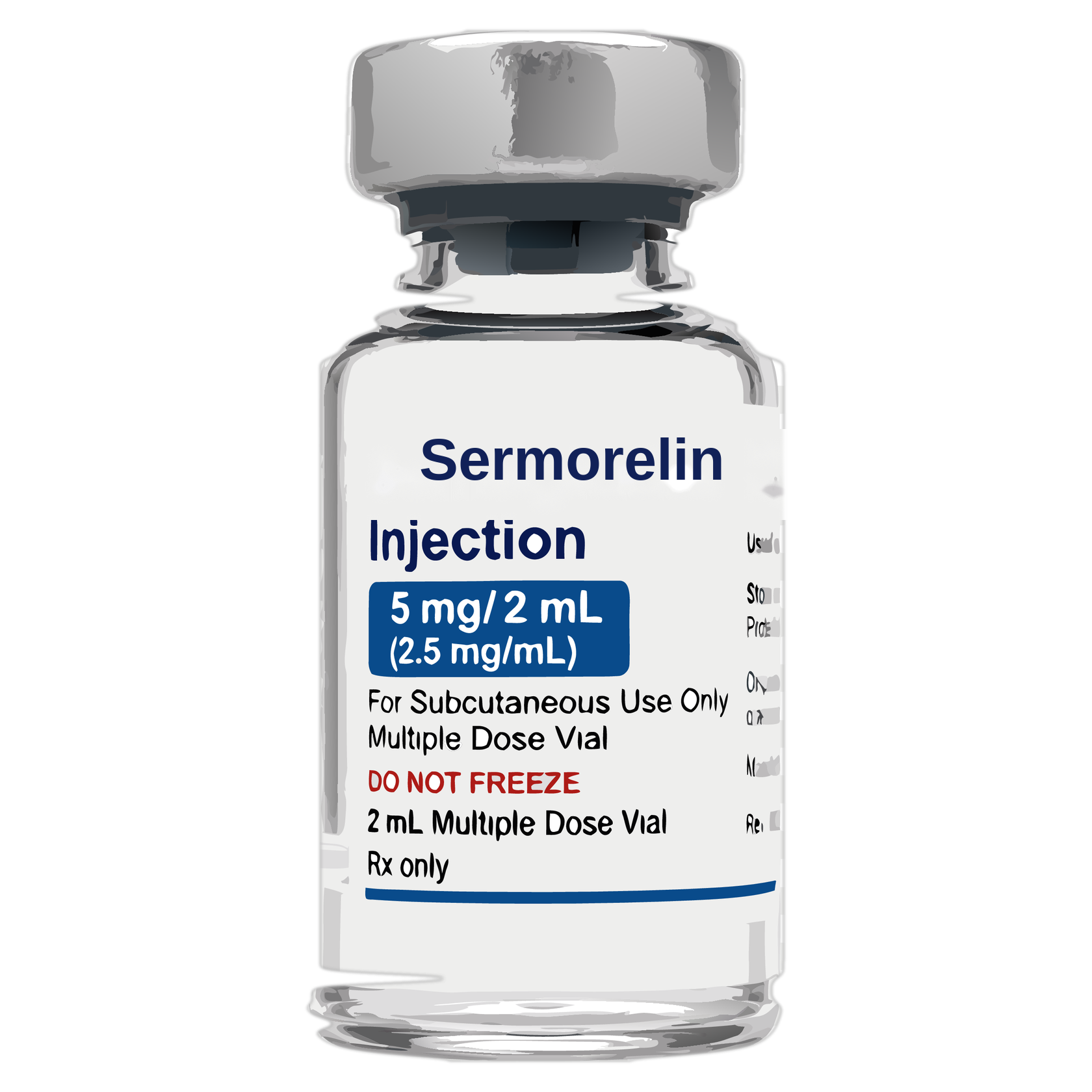
Sermorelin
Sermorelin is a growth hormone-releasing hormone (GHRH) analog representing the first 29 amino acids of natural human GHRH. It was FDA-approved from 1990-2008 under the brand name Geref for diagnosing and treating pediatric growth hormone deficiency, before being discontinued for commercial (not safety) reasons.
- Stimulates the pituitary to naturally release growth hormone
- Formerly FDA-approved (as Geref) for pediatric GH deficiency
- May support lean mass, recovery, and sleep depth
No commitment · Cancel anytime · Physician evaluation required
About Sermorelin
Sermorelin (GHRH 1-29) stimulates the pituitary's own GHRH receptors to release growth hormone in a natural, pulsatile pattern, rather than supplying growth hormone directly.
What the research shows
Sermorelin has an unusually well-documented regulatory history for a wellness-market peptide: it was FDA-approved in 1990/1997 (as Geref) based on pediatric trials showing significant increases in height velocity in children with GH deficiency. EMD Serono discontinued the product in 2008 for commercial reasons — the FDA later confirmed in a 2013 Federal Register notice that the withdrawal was not related to safety or effectiveness. Adult evidence, however, is meaningfully thinner than the pediatric data that supported approval: a 2020 review in JCSM Rapid Communications notes promising but not fully developed results in muscle wasting, HIV lipodystrophy, and cognitive decline, with further clinical development not reported.
Who it's for
Sermorelin is often considered by adults interested in GH-axis support for body composition, recovery, and sleep quality, with the understanding that today's adult wellness use rests on a smaller evidence base than the pediatric data behind its original approval.
How It's Administered
Sermorelin is typically administered as a subcutaneous injection at bedtime, timed to work with the body's natural nighttime GH pulse. Your physician will determine an appropriate protocol during your evaluation.
Safety & Considerations
The pediatric trial safety profile was well-established through the FDA approval process, generally described as mild, with injection site reactions being most common. Adult long-term safety data is less extensive than for the pediatric-approved use.
Your physician will review your health history during your evaluation. Not all applicants will qualify.
Selected References
The following peer-reviewed sources informed the summary above. Evidence quality varies — some reflect large controlled human trials, others early-stage or animal research, as noted.
- Growth hormone secretagogues: history, mechanism of action, and clinical development
JCSM Rapid Communications (Wiley), 2020